Elizabeth Cady StantonNovember 12, 1815 - October 26, 1902 Childhood 1815-1830 Elizabeth Cady Stanton was born on November 12, 1815 to Daniel Cady, a prominent judge, and Margaret Livingston. She was born the same year Daniel Cady was elected to Congress. Elizabeth grew up in Johnstown, New York. She grew up in an orderly and disciplined home. Her family attended the Scotch Presbyterian Church. The church's theology was predestination and eternal damnation which frightened Elizabeth as a child. She lived in constant fear that her rebellion would cause the devil to claim her as his. As she grew older her fear changed to anger when she realized the effect that religion had on women's lives. One bright spot to the church was the minister, Reverend Simon Hosack, who lived next door to the Cadys. He was a warm and affectionate person and a great source of comfort to Elizabeth. He contributed greatly to her intellectual development. He treated her as a companion and they would talk for hours. He would take great pains to explain words or allusions that she did not understand. This helped her to develop a superior knowledge of the English language. Additionally, from their long talks she acquired courage and self-confidence in expressing her ideas. Elizabeth's earliest memory at the age of four is the birth of a sister. She recalls the people who were present and the conditions of the room. The most significant memory of the birth was when so many people remarked "What a pity it is she's a girl." Their remarks made Elizabeth feel pity for the baby. As a young child Elizabeth remembers being under punishment quite often for what was called in those days "tantrums" (Stanton, 1993/1898). There were five children in the Cady home, four daughters and one son, Eleazer. Eleazar was the third child and Elizabeth the fourth. It was clear very early to Elizabeth that Eleazar was more important to her father than all the girls put together. After Eleazar graduated from Union College he returned home, became ill and died. Daniel Cady was inconsolable. Elizabeth, who was eleven at the time, tried very hard to comfort her father. Daniel always responded with "Oh, my daughter, I wish you were a boy!" This statement made Elizabeth determined to be all her brother was and could have become. Elizabeth hugged her father and replied "I will try to be all my brother was." Because of her new found determination to fill her brothers shoes she learned to ride a horse, studied Greek, and became the only girl in a class of boys studying Latin and mathematics at Johnstown Academy. Even though the judge was pleased with her accomplishments he always stated that she should have been a boy. Her friend Reverend Hosack often comforted Elizabeth when her father would crush her spirits. Daniel Cady did however recognize his daughters abilities and gave her more encouragement than most fathers would have during those years. He allowed her to sit in his law office when he had clients, many of whom were women. Elizabeth learned early about the legal rights denied to women. Once a woman married, all of her inheritance went to her husband. Divorce in those days would end a woman's right to her children. Daniel Cady would show Elizabeth law books and the laws restricting women's rights. In her autobiography Eighty Years and More Elizabeth depicts herself as a child rebel, who upon hearing the laws restricting women, planned to "cut everyone of them out of the books; supposing my father and his library were the beginning and the end of the law" (as cited in Hogan, 2009, p. 9). Her father told her that maybe she could one day persuade legislators to pass new laws. Elizabeth took his statement very serious. Yet, Daniel Cady would one day disapprove of his daughter appearing in public to speak, even though he agreed with the laws she was trying to get passed. After Elizabeth's older sister was married the couple took over much of the care for Elizabeth and her younger siblings. This was a blessing because they introduced them to picnics, birthday parties, fairy tales, ponies, and frequent trips. Since Elizabeth's brother-in-law Edward Bayard had just graduated from college he took over all the children's lessons in Latin, Greek, and mathematics and made them enjoyable for a change. At the age of sixteen Elizabeth graduated from the Johnstown Academy. She was not allowed to attend Union College because she was a girl. Her parents agreed to send her to the Troy Female Seminary which was the most advanced school for girls. Even though the school was advanced for the period, it was still inferior to the education level of the men's colleges. Elizabeth did not like the atmosphere of the all-girl school and this lead her to become a strong supporter of co-education. (Gurko, 1974) & ( Stanton, 1993/1898) Watch this PBS special to learn more about Elizabeth Cady Stanton's life and history: http://www.pbs.org/stantonanthony/movement/index.html
|
||
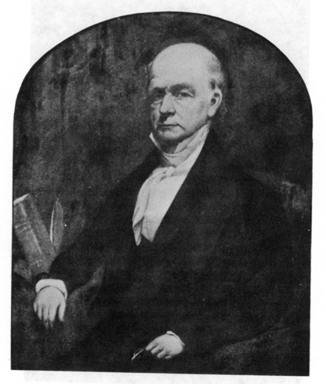 Elizabeth's Father Elizabeth describes her father as a man of unimpeachable integrity, very sensitive, and modest. However, his dignified repose and reserved manner caused his children to regard him with fear instead of affection. (Stanton, 1993/1898) |
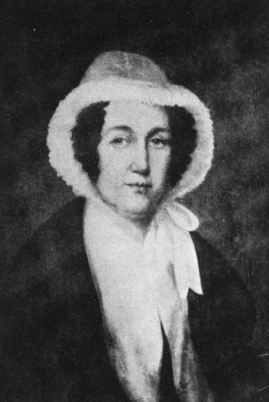 Elizabeth's Mother Margaret Livingston - the daughter of James Livingston, an officer in the American Army during the Revolution. (Stanton, 1993/1898) |
|
