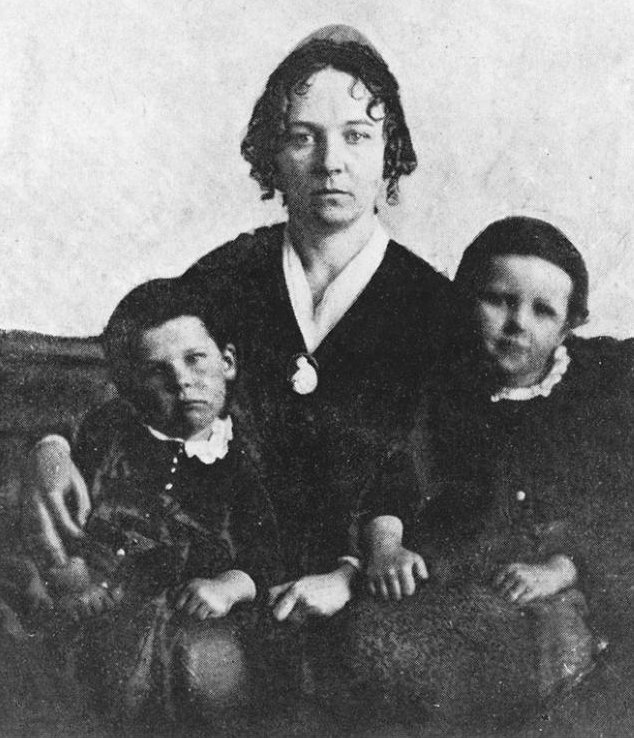
Marriage & FamilyElizabeth describes the time during her engagement to Henry B. Stanton as a time of doubt as to whether it was wise to give up her life of freedom and enjoyment for the unknown. It was also a time of conflict with her father because he was not happy with her decision to marry an abolitionist. Because of this doubt and conflict Elizabeth broke her engagement off after several months. However, Henry was scheduled to go to Europe as a delegate to the World's Anti-slavery Convention and Elizabeth did not want to be so far away from him. It is for this reason that they renewed their engagement, and without any preparation were married and headed on a voyage to Europe. Elizabeth convinced the Scottish clergyman to marry them on a Friday (which according to superstition was a bad day to marry) and to leave the words "to obey" out of the ceremony. There were a few friends present at the ceremony and Elizabeth wore a simple white evening dress. On May 11, 1840 Elizabeth Cady married Henry B. Stanton. However, she did not take the traditional married name of Mrs. Henry B. Stanton but instead would hereafter be called Mrs. Elizabeth Cady Stanton. (Stanton, 1993/1898) |
||||||||||||
At the World's Anti-slavery Convention in London (June 12, 1840) delegates from anti-slavery societies representing associations of women were rejected upon their arrival. According to English prejudices, women were excluded from sharing authority with men in all reform associations. Elizabeth's husband made a speech in favor of admitting the women delegates. At the convention Elizabeth met women such as: Lucretia Mott, Sarah Pugh, and Sarah Grimke. These women were members of the Boston and Philadelphia female antislavery societies. The act of not allowing women to speak at this convention moved many women into action and gave rise to the women's political equality movement both in Europe and the United States. In Europe, Mrs. Mott and Elizabeth decided to hold a women's rights convention when they returned home. (Stanton, 1993/1898) Once Henry and Elizabeth returned home Henry decided to study law with Daniel Cady. This kept Elizabeth at home with her family for two more years and gave her precious time with her sisters. While under her parental roof she gave birth to her first child, Daniel Cady Stanton. Elizabeth states in her autobiography that," though motherhood is most important of all the professions, - requiring more knowledge than any other department in human affairs,- yet there is not sufficient attention given to the preparation for this office" (Stanton, 1993/1898). Since Elizabeth had little faith in the popular theories of that day, she began to observe and read about childcare and babies. However, she trusted no men or books completely and relied mainly on her "mother's instinct" when raising her children. Her conclusions were that the temperature of a child's bath should be regulated by a thermometer (not an elbow), that a baby should not be bandaged or swaddled with no freedom to move, and that babies needed fresh air and sunlight. The nurse she had for the first six weeks after the birth of her first born fought with her on these ideas. She replaced her first nurse when the baby was six weeks old with a woman that would listen to her orders. Elizabeth took it upon herself to help other young mothers that did not seem to know what to do with their babies. She gave unsolicited and solicited advice when she would encounter these women. Elizabeth would go on to have seven children. She would be married to Henry B. Stanton for forty-seven years until his death in 1887. She considered her marriage a success (according to her statement in her autobiography) when she discounted the superstition that it was bad luck to marry on a Friday. She states, "we lived together without more than the usual matrimonial friction, for nearly a half a century, had seven children, all but one of whom are still living, and have been well sheltered, clothed, and fed, enjoying sound minds in sound bodies, no one need to be afraid of going through the marriage ceremony on Friday for fear of bad luck." (Stanton, 1993/1898) |
|
|||||||||||